“Toxic at the Top?” What Co-Op Culture data really says

Co-Op Culture deemed Toxic

A recent BBC article reports that senior Co-op staff have described the culture at the top of the organisation as “toxic.”

That’s a strong word. And when it’s used by senior leaders — not just frontline colleagues — it signals something deeper than day-to-day frustration. It points to structural cultural issues: power dynamics, trust breakdowns, misalignment between leadership intent and employee experience.

But what does the data say?

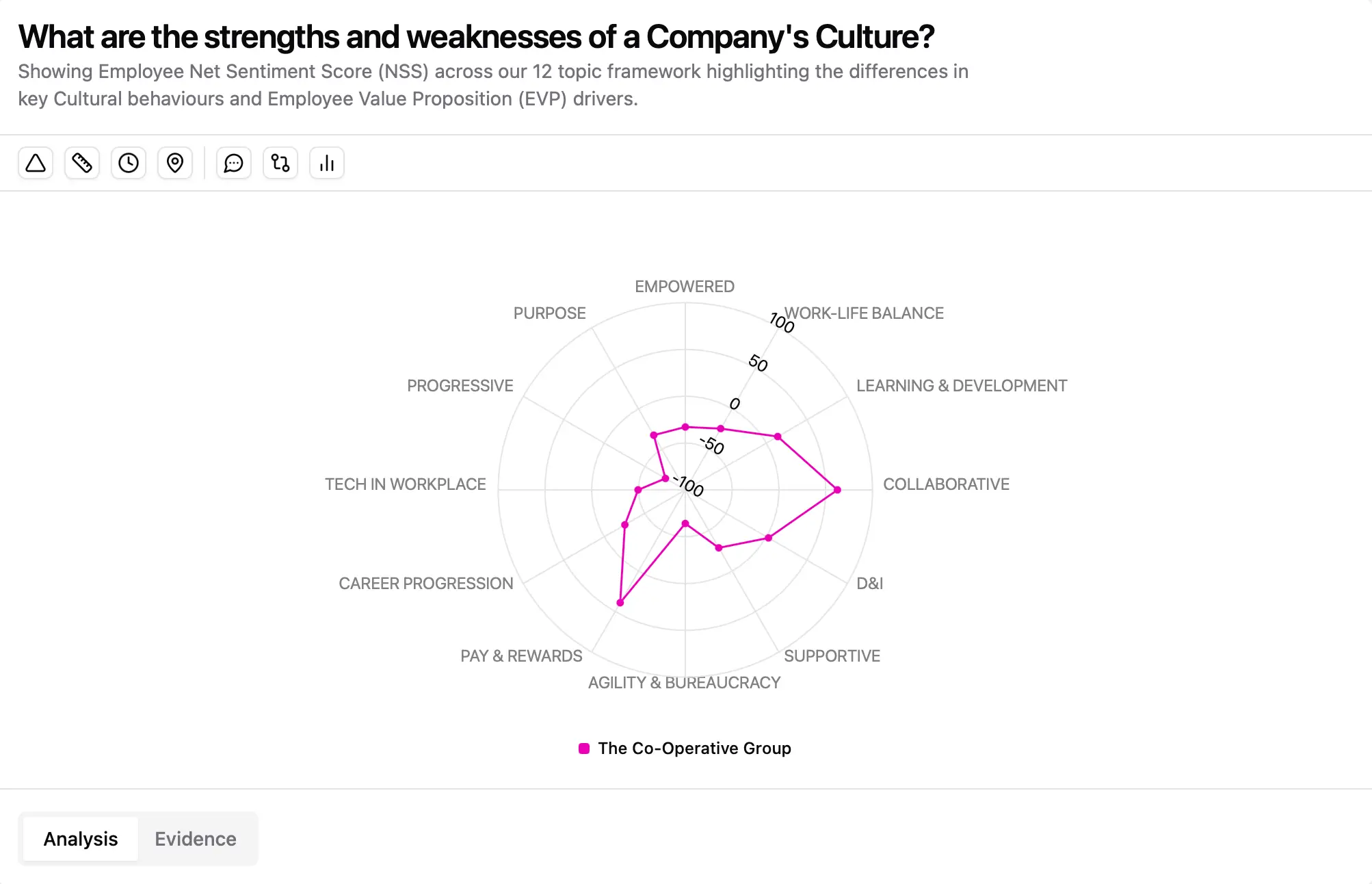
Using Deltabase’s Culture Intelligence analytics, we analysed employee sentiment across our 12-topic framework to understand the strengths and risks in The Co-operative Group’s culture — and how these might connect to the concerns raised publicly.

A recent BBC article reports that senior Co-op staff have described the culture at the top of the organisation as “toxic.”
Click to zoom

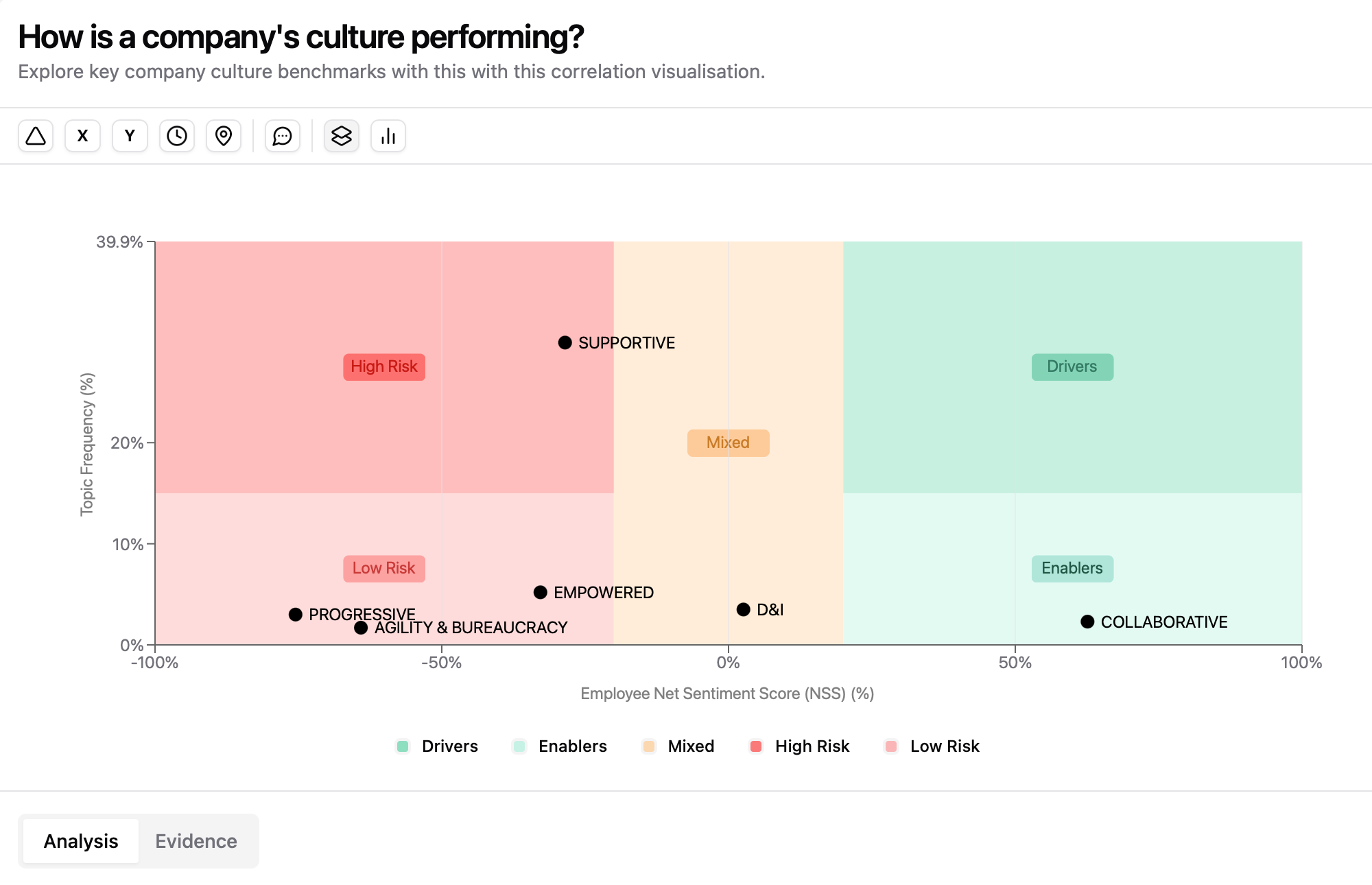
The Culture Correlation View: Where Risk Is Concentrated

Our correlation model maps two things:

  • Employee Net Sentiment Score (NSS)

  • Topic frequency (how often employees are discussing the issue)

This allows us to distinguish between:

  • Drivers (high frequency, positive sentiment)

  • Enablers

  • Mixed

  • Low Risk

  • High Risk (high frequency, negative sentiment)

For The Co-operative Group, several topics fall firmly into high-risk territory:

Progressive (-75.5)

One of the most negative scores in the dataset.

This suggests employees perceive:

  • Resistance to change

  • Cultural stagnation

  • A gap between transformation rhetoric and reality

If senior leaders are describing culture at the top as toxic, low “Progressive” sentiment often reflects frustration with decision-making processes, innovation blockers, or leadership style.

Agility & Bureaucracy (-64.1)

Heavy bureaucracy and slow decision cycles are clear pain points.

In organisations where bureaucracy dominates:

  • Accountability becomes blurred

  • Frustration escalates upward

  • Senior leaders feel trapped in governance complexity

“Toxic” cultures often emerge where process overrides people.

Tech in the Workplace (-49.5)

This aligns directly with our earlier analysis in:

👉 The Hidden Cost of Co-op Technology Failure

When technology systems frustrate rather than enable, it:

  • Amplifies stress

  • Slows collaboration

  • Undermines empowerment

  • Erodes trust in leadership decisions

Technology rarely causes toxicity on its own — but it magnifies existing cultural friction.

A recent BBC article reports that senior Co-op staff have described the culture at the top of the organisation as “toxic.”

Clear Strength: Collaborative (+62.6)

The Co-op scores strongly on collaboration.

This suggests:

  • Strong peer relationships

  • Solid teamwork at operational levels

  • Cultural cohesion among colleagues

This is important.

When collaboration is strong but leadership culture is questioned, it often indicates a top-down disconnect rather than a company-wide morale collapse.

Mixed: D&I (+2.6)

Neutral to slightly positive.

There is no strong cultural rejection here — but also no strong advocacy signal.

Weaknesses: Empowerment (-32.8), Purpose (-32.5), Supportive (-28.5)

These are critical.

If employees feel:

  • Under-empowered

  • Disconnected from purpose

  • Unsupported by leadership

Then senior leaders are likely feeling that tension too.

“Toxic at the top” often correlates with:

  • Low psychological safety in executive spaces

  • Blame culture during performance pressure

  • Leadership churn

  • Strategic instability

And the data suggests risk in exactly those enabling themes.

The Career & Reward Paradox

Interestingly:

  • Pay & Rewards: +39.2

  • Learning & Development: +14

This suggests employees don’t necessarily see compensation or development as the core problem.

That’s important for HR leaders.

Toxicity is rarely about pay.

It’s about:

  • Decision-making culture

  • Leadership behaviour

  • Accountability

  • Power dynamics

  • Bureaucratic drag

Money doesn’t offset cultural friction at the top.

When Collaboration Is Strong but Leadership Feels Toxic

This combination is telling:

Theme Score
Collaborative +62.6
Progressive -75.5
Agility & Bureaucracy -64.1
Empowered -32.8

This often reflects a “strong middle, strained top” dynamic.

Colleagues work well together.
But strategy execution, governance, and executive alignment create friction.

In these cases:

  • The frontline culture may be resilient.

  • The executive culture may be volatile.

And volatility at the top cascades quickly.

What This Means for HR Leaders

When headlines describe a culture as “toxic,” it’s rarely about a single individual or isolated incident. More often, it’s the visible symptom of deeper structural pressure building over time.

The Co-op data doesn’t suggest universal disengagement. Collaboration is strong. Pay and rewards are not driving dissatisfaction. Learning and development isn’t collapsing. This is not a motivation crisis.

What the data does show is something more subtle — and more systemic.

It reveals strong peer relationships alongside weak structural enablers. Heavy bureaucracy. Deeply negative sentiment around progressiveness and agility. Reduced feelings of empowerment. Friction with workplace technology.

That combination points to an alignment issue rather than an effort issue.

When collaboration is high but agility and progressive culture are deeply negative, it often reflects a “strong middle, strained top” dynamic. Colleagues work well together, but governance complexity, slow decision-making and strategic misalignment create frustration. And that frustration tends to intensify at senior levels first.

For HR leaders, the instinct when reading stories like this may be to distance your own organisation from the narrative. But the more productive question is whether your own culture data would reveal similar patterns.

Is your organisation collaborative but bureaucratic?
Does your transformation narrative match lived experience?
Do senior leaders feel psychologically safe — or politically exposed?
Is empowerment tangible, or just language in a strategy deck?
Is technology enabling performance, or compounding stress?

Toxicity rarely appears suddenly. It builds where change feels blocked, where trust erodes, where process overtakes purpose, and where leadership alignment fractures. By the time it becomes visible in headlines, it has usually been measurable in sentiment for months — sometimes years.

The question isn’t whether an organisation has a “toxic culture.”

It’s whether structural pressure points are being identified early enough — before they escalate to the top.

Because culture at the top is not separate from the rest of the organisation.

It is amplified.

And the real leadership challenge isn’t avoiding negative headlines.

It’s diagnosing misalignment before it becomes one.
 

Want to See Your Culture in Context?

If you’re responsible for people, culture, or strategy — we’d love to show you what’s going on in your business and how it compares to your peers.

👉  Book a Culture Intelligence demo
👉  Explore our full platform

http://deltabase.one

Leroy Hall is a strategy and culture specialist at Deltabase, where he helps organizations unlock insights into leadership, workforce, and cultural dynamics through data-driven intelligence.